What Does "Likeness" Actually Mean?
/By Annika Howe

There's a particular kind of confusion that shows up in production offices lately, and it isn't about budgets or call times. It's about a handful of terms — usage rights, likeness rights, digital replicas, AI training, derivative content — that have started appearing in the same paragraph of a contract, often used as though they mean roughly the same thing.
They don't. And the gap between them is quickly becoming one of the more consequential distinctions in commercial production.
This vocabulary comes largely from entertainment law, a world most photographers, stylists, producers, and models were never trained to navigate. It's being absorbed into advertising and commercial contracts faster than most of the industry has had time to build a shared, plain-language understanding of what it actually covers. The result is a lot of very careful people signing very specific language without a clear sense of what they've agreed to.
So it's worth slowing down and taking each term on its own.
Usage Rights: The Familiar Layer
Usage rights are the part of a contract most production professionals already know how to read. They describe where and how a specific piece of content — a photograph, a video, a campaign asset — may be used: which platforms, which territories, for how long.
This is the layer that's always been negotiated directly. A regional print buy is a different conversation from a global paid social campaign. A six-month usage window is a different conversation from a perpetual one. Producers have built entire careers on knowing how to read and negotiate this exact language, and for good reason — it's where a huge amount of a project's real value sits.
In short: usage rights govern the content. They answer the question, where is this specific image or video allowed to appear?
Likeness Rights: A Broader, Older Idea
Likeness rights are a different, and in some ways older, category. They concern a person's identifiable features — face, body, voice, mannerisms — independent of any single photograph or piece of footage. A likeness right doesn't ask can we use this image of you. It asks can we use you, in a more general and durable sense.
Likeness has existed as a legal concept in entertainment and advertising for a long time, largely built around the idea that a person's identity has commercial value and shouldn't be used without consent — even outside the specific frame of a single shoot. What's changed is the context it now sits inside. As technology makes it increasingly possible to separate a person's likeness from the specific moment it was captured, likeness rights are taking on new weight, and new complexity, inside standard production paperwork.
In short: likeness rights govern the person, not the photograph. They answer the question, what am I allowed to do with your identity, beyond this specific piece of content?
Digital Replicas: The Sharper Edge
Digital replicas are the newest and most specific term in this vocabulary, and the one causing the most genuine uncertainty. A digital replica is a synthetic, AI-generated recreation of a real person — built from existing photographs, video, or scans — capable of being animated or rendered saying and doing things that were never actually filmed.
A digital replica clause isn't asking permission to publish what was captured on set. It's asking permission to generate something that wasn't. That's a meaningfully different request, and one that's easy to miss when it's folded into the same paragraph as ordinary usage language.
Consider an ordinary example: a photographer shoots a campaign for a skincare brand. A traditional usage clause governs whether that photograph can run in a magazine, on a billboard, or across a paid social campaign for a defined window of time. A digital replica clause, tucked into the same paperwork, might separately govern whether the brand can later generate an AI-rendered video of that same model — in a pose she never struck, delivering a line she never spoke — without booking her, or the photographer, again.
In short: digital replica rights don't govern what was made. They govern what could be made afterward, using someone's likeness as raw material.
AI Training: A Use Case With No Campaign Attached
AI training clauses address a different question entirely: whether the images or footage from a specific shoot can be used to train machine learning models. This has nothing to do with the campaign the content was originally shot for, and everything to do with how that material might shape future, often entirely unrelated, AI systems.
This is worth calling out specifically, because it's rarely stated in those exact words inside a contract. A clause might reference "improving our systems and services" or similar broad language, without ever using the phrase "AI training" directly — which makes it one of the easiest provisions to sign without fully registering what it permits.
In short: AI training clauses aren't about this campaign at all. They're about whether this material becomes an input for something else, later, elsewhere.
Derivative or Synthetic Content: The Catch-All
Derivative or synthetic content is the broadest of these categories, covering anything generated or substantially altered by AI from the original material. That might be an extended version of a shoot, a translated or re-voiced version of a spot, or an entirely new asset built from a model's likeness without a new booking or a new day rate.
Because this category is broad by design, it's often where the most protective language — or the most concerning gaps — actually live. A contract that's precise about usage and vague about derivative content has, in effect, left the door open on the exact question that matters most right now.
In short: derivative content clauses determine whether something new can be built from what was originally made — and whether that new thing requires a new conversation.
Why the Distinction Is Worth Holding Onto
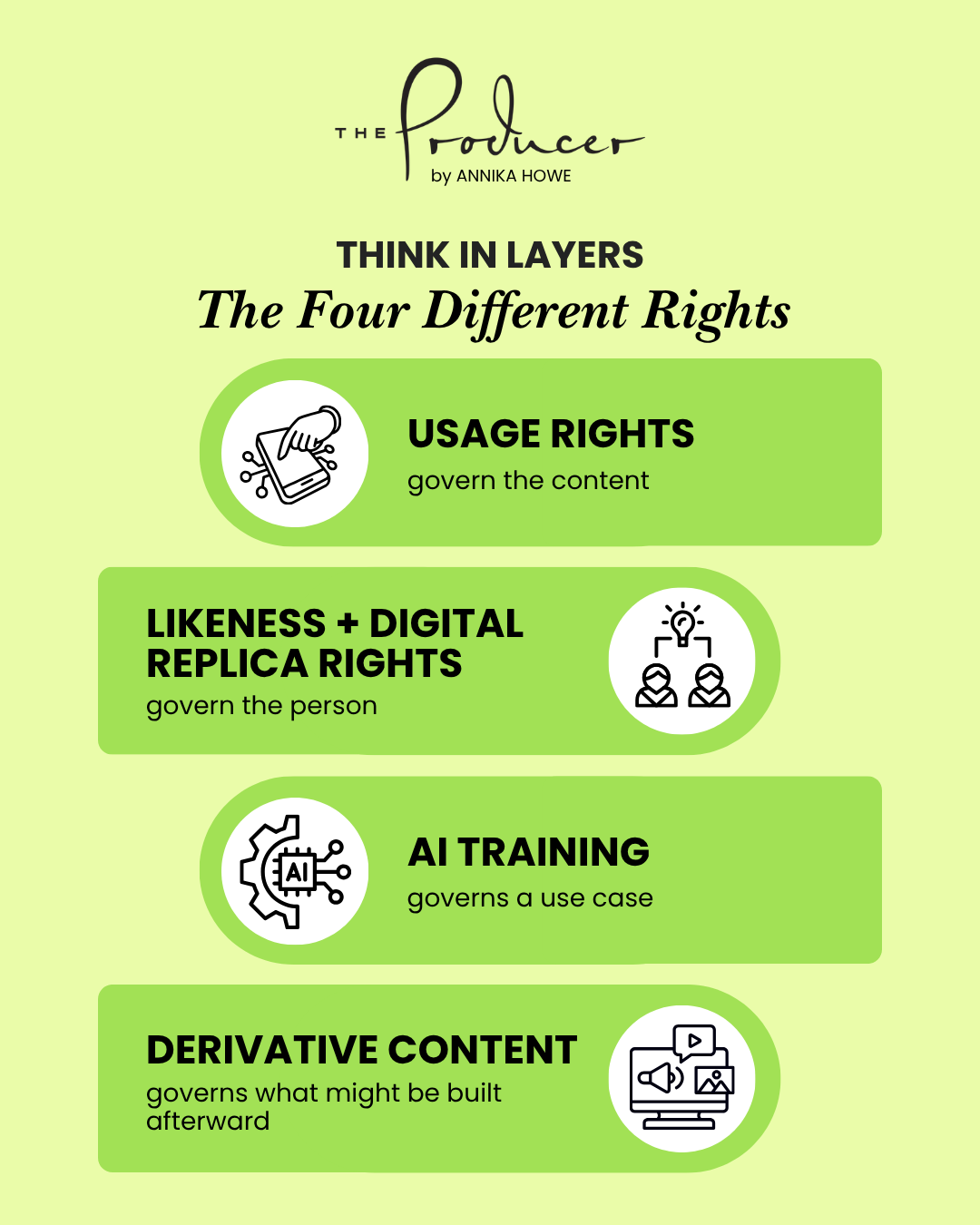
None of these terms are interchangeable, even though they frequently appear side by side in the same document. Usage rights govern the content. Likeness and digital replica rights govern the person. AI training governs a use case entirely separate from the original campaign. Derivative content governs what might be built afterward, from the raw material of someone's identity and work.
Reading a contract with these distinctions in mind changes the questions worth asking before signing anything: not just where will this run, but what, exactly, does this allow to be made from me, or from my work, after the fact.
That's not a legal judgment — it's a vocabulary. And like most vocabulary worth learning, its real value shows up quietly, the next time a contract lands on a desk and a sentence, buried three pages in, suddenly makes sense.